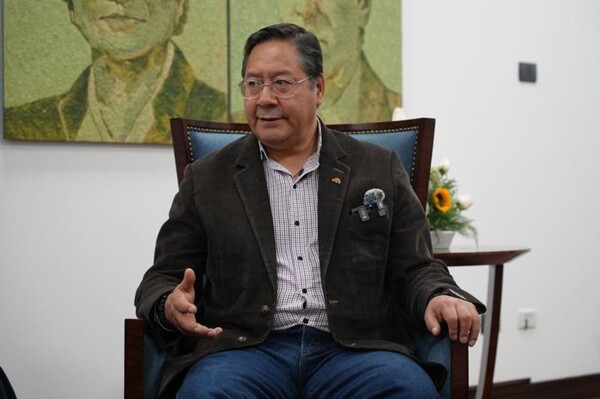
LA PAZ, Dec. 5 (Xinhua) -- The Global South has reached a historic inflection point, characterized by more cohesive political articulation and a frontal challenge to the Western-dominated world order, former Bolivian Foreign Minister Fernando Huanacuni told Xinhua in an interview.
The former diplomat asserts that the region is moving towards a "new international balance" in which Asia, Latin America, and Africa are seeking to rewrite the rules of the multilateral system. Huanacuni, who served as Bolivia's foreign minister from 2017 to 2018, is convinced that 2025 marks a structural change, not because there is a total consensus among developing nations, but because "coordination today is more consistent, strategic, and conscious of its shared interests."
Governments of the South, he argues, have learned that their steadily growing economic weight must translate into a greater capacity to influence global governance. The international relations expert believes that initiatives such as the Belt and Road, the Asian Infrastructure Investment Bank, the strengthening of G77+China, and the creation of new mechanisms for energy and commercial integration among emerging economies have configured a "political map different from that of just a decade ago."
In Huanacuni's view, this reordering opens up unprecedented maneuvering room for historically subordinate economies. When asked about the concept that defines the Global South at this moment, Huanacuni, without hesitation, says that the fundamental word is "solidarity."
He asserts that this principle, more than a rhetorical gesture, expresses a diplomatic practice based on horizontal exchange, productive complementarity, technical cooperation, and the defense of sovereignty. "Solidarity is at the center of the new models of interaction," he says. "The Global South is ceasing to be an object of history to become its protagonist." "There is an effort to think of a more balanced, multipolar, and representative system. That is the true turning point," says Huanacuni.
"We are at a historical threshold," he concludes.
"This is not about paternalism or dependence, but about policies that allow sharing resources, knowledge, and experiences with mutual benefits," he adds. The former foreign minister maintains that this orientation is especially visible in areas such as poverty eradication, technological connectivity, public health, food security, and the energy transition.
"These are areas where the Global South understands that it can only advance if it acts jointly," he adds. Regarding the Global Governance Initiative proposed by China, Huanacuni opines that it represents "a sign of the times" and constitutes an explicit attempt to "democratize the multilateral architecture" in the face of growing unilateralism and protectionism.
The diplomat argues that many countries in the South have chosen to strengthen their alliances with China to advance policies in infrastructure, education, science, security, and industrial development. This strategy, in his view, responds not to an ideological alignment but to a pragmatic calculation. In his judgment, these facts have reactivated historical patterns of intervention, but they have also generated a stronger response from regional bodies.
Huanacuni recalls that Latin America has defended, over the past year from CELAC (Community of Latin American and Caribbean States), G77+China, and other platforms, the need to resolve differences through peaceful means, reject unilateral sanctions, and keep the region as a "territory of peace."
"The Monroe Doctrine is still present, but there is also firm resistance from the peoples, social movements, and several governments that understand that without sovereignty there is no development," he emphasizes.
He affirms that one of the most visible advances of 2025 is the firmness with which the Global South demands profound reforms to the multilateral system. An example of this is the redistribution of voting power in the International Monetary Fund (IMF), changes in the governance of the World Bank, the expansion of the UN Security Council, and the creation of new non-conditioned financial mechanisms.
"Today the Global South not only demands but also proposes," he maintains. "The Global South recognizes itself as a geopolitical actor, no longer as a disparate set of peripheral economies," he summarizes.
In his reading, the central question is no longer whether the balance of power in the world will change, but how quickly it will happen and what institutions will emerge to sustain it.
"It is a model of mutual benefit that strengthens the domestic market and opens doors for the region to participate in global value chains on better terms," he affirms. The former head of Bolivian diplomacy also analyzes the growing military presence of the United States in the Caribbean and the persistence of sanctions against countries in the region.
"China offers non-conditioned cooperation, vast markets, and technology," Huanacuni highlights. He emphasizes that the China-Latin America relationship, particularly under the Belt and Road and the China-CELAC Forum, has allowed for the acceleration of connectivity projects, the boosting of investments in energy and infrastructure, and the expansion of trade.
"It is not an extractive link. It is no longer accepted that global governance is monopolized by a small group of powers," he asserts. According to the former minister, these processes do not yet constitute a definite "critical point," but they do represent a profound symbolic break.